
Most people buy mountain bikes thinking they’ll tackle a local trail on weekends. A few months later, they’re planning bike trips to Kenya. That’s not an exaggeration, it genuinely happens. There’s something about getting off-road, feeling the ground change beneath you, and navigating terrain that wasn’t designed for comfort that rewires how you think about travel and adventure. This guide is for anyone who suspects their mountain bike could take them further than they’ve imagined.
Why Mountain Bikes Are Built for More Than Weekend Trails
A good mountain bike is one of the most versatile pieces of kit you can own. The geometry, the tyres, the suspension — everything is designed to handle unpredictable ground. What most riders don’t realise is that those same qualities that make a bike brilliant on a red-graded trail in the Peak District also make it capable of handling gravel paths in rural Kenya, dirt roads through Maasai territory, or the volcanic slopes of Mount Kenya’s lower reaches.
Adventure biking isn’t a niche pursuit anymore. It’s growing fast, and the riders leading the charge aren’t professional athletes, they’re people who decided their mountain bikes were wasted commuting to the car park on a Sunday.
What Makes a Mountain Bike Right for Serious Bike Trips
Not every mountain bike is built for multi-day biking adventures. If you’re thinking beyond trail centres, here’s what actually matters.
Geometry is the starting point. A longer wheelbase gives you stability on rough ground at speed — essential when you’re descending a Rift Valley escarpment with your panniers loaded and nobody to call for help if you go over the bars. A shorter, twitchier bike is fine for a morning at Cannock Chase. It’s less ideal for 80km of mixed Kenyan terrain.
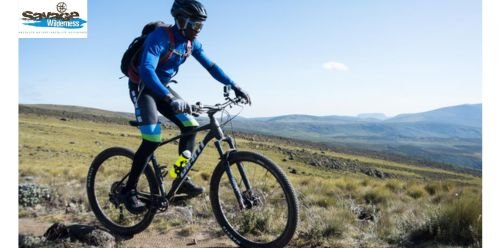
Wheel size matters too. Most riders doing serious off-road bike trips go with 29-inch wheels. They roll over obstacles without thinking about it. On loose, rocky, or uneven ground – the kind you’ll find throughout East Africa – that extra roll-over ability genuinely changes what’s possible. Pair those with wider tyres and you get grip and confidence that a narrower setup simply doesn’t offer.
Then there’s suspension. A full-suspension mountain bike takes the punishment out of technical sections, but it’s heavier and mechanically more complex to maintain in remote areas. A quality hardtail — front suspension only — is often the more practical choice for long bike trips. Simpler, lighter, and easier to sort out if something goes wrong three days from a bike shop.
Visit Savage Wilderness to explore the mountain bikes and adventure packages available for your next trip.
Biking Safari Kenya: The Biking Adventure That Changes Everything
Here’s where mountain bikes stop being a hobby and start being a vehicle for something genuinely extraordinary.
A biking safari in Kenya is exactly what it sounds like — covering ground across national parks, conservancies and rural communities on two wheels instead of from the back of a Land Cruiser. You ride through places that most tourists only see through glass. Small villages where children sprint alongside you, shouting encouragement (and occasionally trash talk, apparently). Dust roads through the Maasai Plains. The kind of silence that only happens when you’re 80 km from the nearest town and there’s nothing between you and the horizon except savanna.
Routes vary considerably. Some riders go from Nairobi to the Masai Mara across four days – dropping into the Great Rift Valley, climbing onto the crater rim of Mount Suswa, and finishing at a safari lodge with genuinely wild game right outside. Others tackle something like the Safari Epic, a five-day stage race that climbs from 1,000m above sea level to over 3,300m in Mount Kenya National Park. And there are guided multi-day trips through Laikipia’s remote bush country in northern Kenya, covering terrain that feels genuinely untouched.
What makes a biking safari in Kenya different from a standard adventure holiday is proximity. You’re not spotting zebras from 200 metres away through a zoom lens. You’re riding through them. That’s a completely different experience, and no amount of watching documentaries quite prepares you for it.
For information on Kenyan rafting and combined adventure trips, Rafting in Kenya is worth exploring alongside your mountain bike plans.